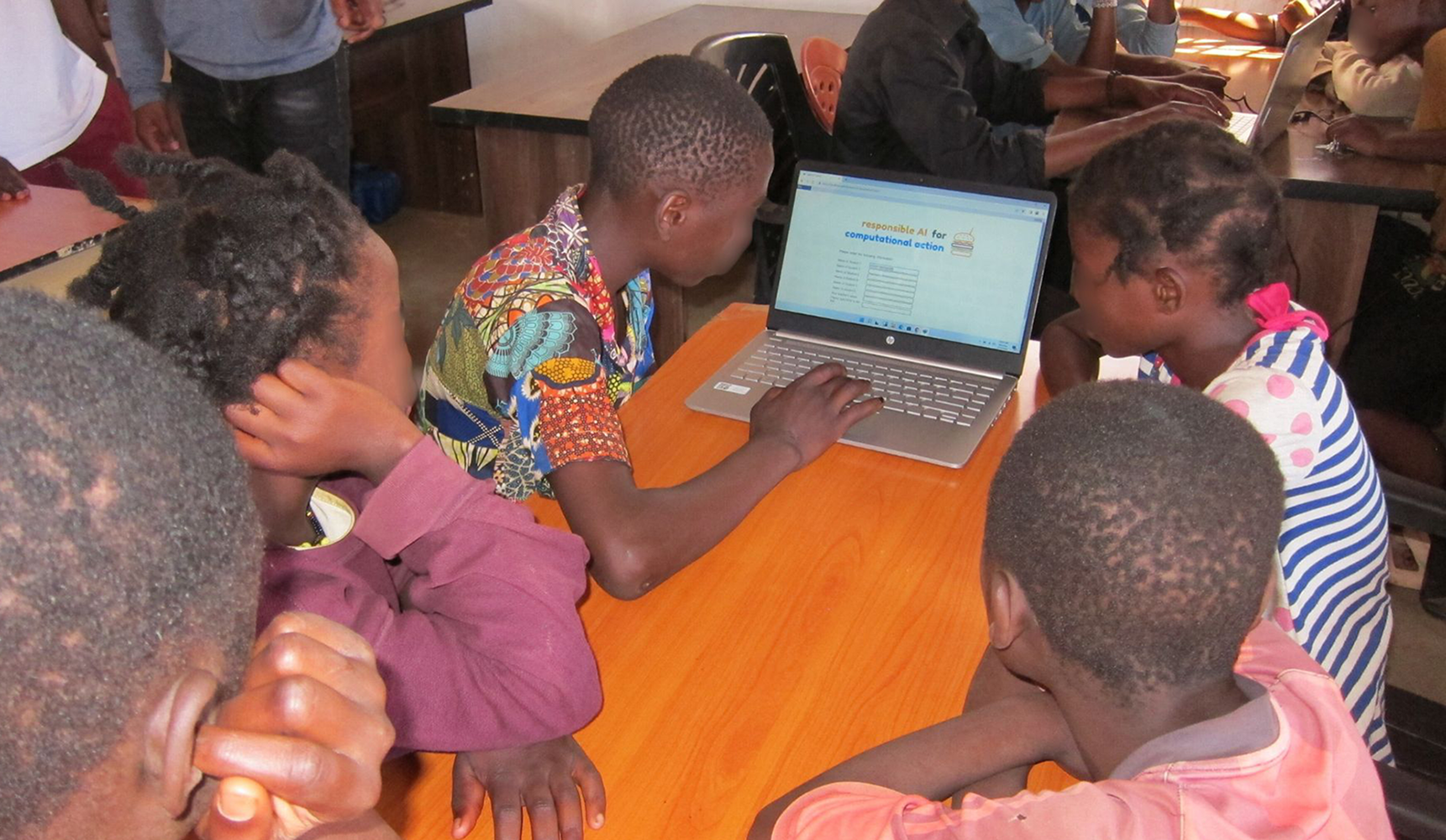
When students first learn about artificial intelligence, the concepts can feel abstract or distant. The Responsible AI for Computational Action (RAICA) curriculum was created to close that gap—giving young people hands-on experiences with AI while grounding their projects in responsible design and community values. Learners explore topics like image classification, computer vision, and affective computing, then apply what they know to design an AI project for a cause that matters to them.
But for RAICA to truly work in diverse contexts around the world, it can’t just be a set of static lessons. It has to adapt to local needs, languages, and educational realities.

A partnership in Malawi
That challenge came into focus in 2022, when the RAICA team began working with Africa Deep AI (ADAI) Circle, a nonprofit based in Malawi’s Dzaleka Refugee Camp. ADAI Circle equips refugees and local youth with training in AI, software development, and hardware design, helping them build skills for economic independence and community development.
Through this collaboration, MIT researchers and ADAI educators didn’t just test materials—they co-designed them. Weekly meetings, interviews, classroom recordings, student project reviews, and surveys helped both teams learn from one another. RAICA staff gained insight into cross-cultural education with multilingual learners, while ADAI teachers and students had a direct role in shaping what the curriculum looked like on the ground.

Rethinking the curriculum
The partnership led to tangible changes. Vocabulary supports were systematized to make technical content more approachable. Key ideas like “design values” and “community” were presented in new ways that resonated across cultures. Examples were chosen with more care, aiming for universality without losing relevance. And materials were designed to be accessible both online and in print, on multiple types of devices.
These adjustments weren’t theoretical—they were born out of the lived experiences of students and teachers at Dzaleka.
Looking ahead
This fall, the work enters a new phase. A 15-student cohort at ADAI Circle will be the first to pilot three refined RAICA modules in sequence: Picture This, Social Robots, and Capstone. After years of iteration, the focus now shifts from improvement to impact.
By studying how students innovate and how teachers guide their learning, the RAICA team hopes to measure the curriculum’s effect—and to deepen the idea that AI is not only a tool to be understood, but also a force for creative agency in the hands of young people.