Overview
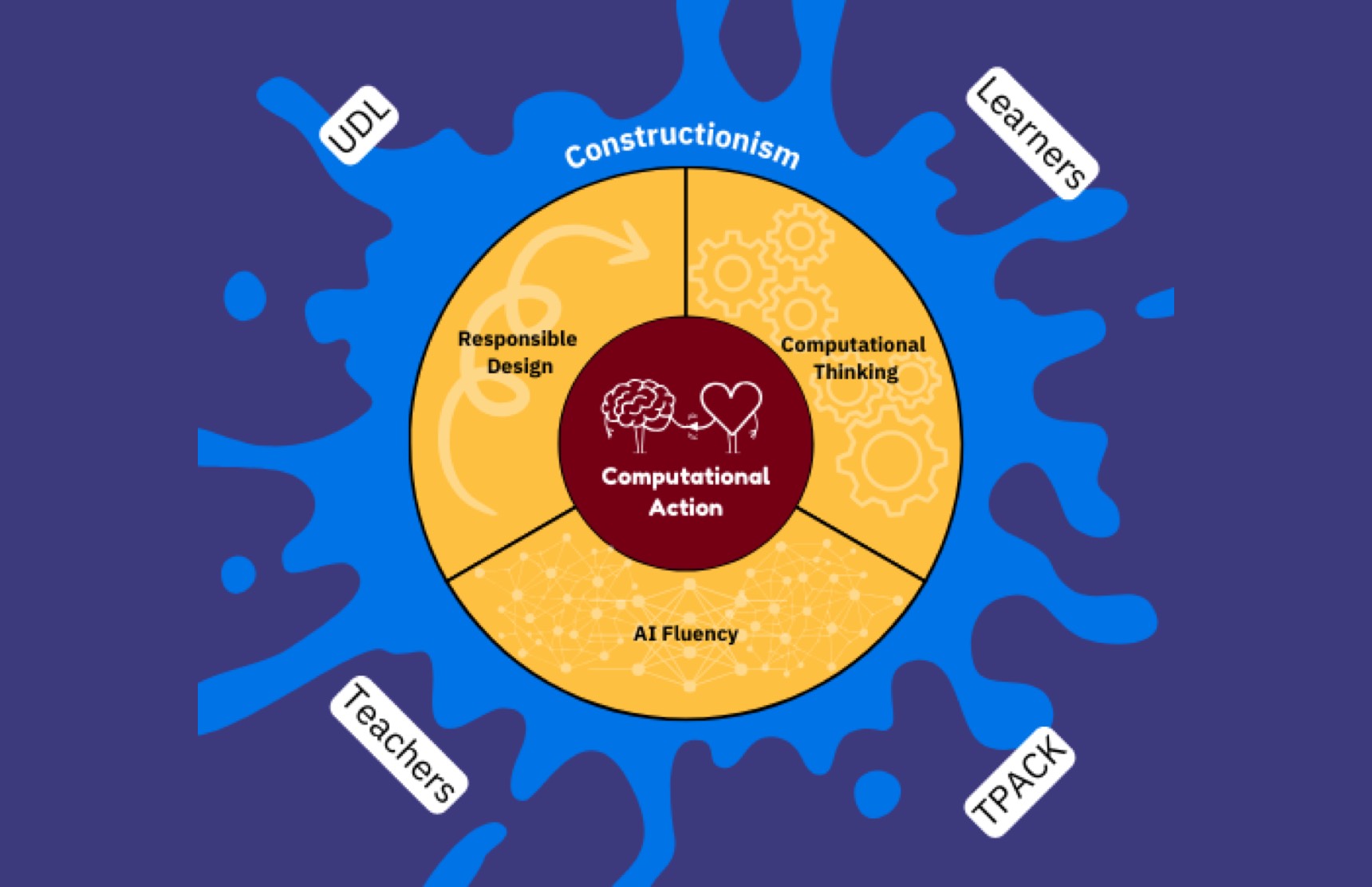
Responsible AI for Computational Action (RAICA) is a project-based curriculum designed to help students and teachers learn about artificial intelligence by tinkering, exploring, and applying new knowledge to build projects they care about. Each module includes lessons to grow AI fluency, apply responsible design, and exercise computational thinking. RAICA applies the Universal Design for Learning guidelines and TPACK framework to create inclusive, empowering, and accessible materials.
All RAICA lessons have been designed to align with AI4K12, CSTA, UNESCO, and UK Computing standards.
Research Details
The goal of the RAICA curriculum is computational action with artificial intelligence for late primary and secondary students. In order for students to take computational action with AI, RAICA has designed lessons that provide opportunities for students to apply computational thinking and responsible design while growing their AI fluency. The curriculum involves conscientious engagement with and ethical design of AI, as well as participation in democratic discussions around artificial intelligence. We approach all of our work through a constructionist pedagogy, a belief that learning is social and happens most deeply in reference to creative production. We use Universal Design for Learning (UDL) and the Technological, Pedagogical, and Content Knowledge (TPACK) frameworks to guide the design of RAICA’s materials to support student and teacher learning.
The overarching purpose of the Responsible AI for Computational Action research study is to provide direction to educational interventions interested in addressing the problem of broadening participation within AI and related computer science fields. This study seeks to advise practitioners (i.e., develop theories of action) and support learners (contribute to instructional theory) on how curricula can empower traditionally underrepresented youth to become AI literate by creating tools and projects that address real-world issues important to them (thus contributing to the research literature on computational action).
Given the novelty of AI and the nascent field of AI education (research and practice), the study takes a design-based research (DBR) approach to the advisory nature of this purpose. Educational DBR is a methodology for conducting research on design and designing with research. DBR involves systematic explorations of how theories and frameworks can be applied to the material design of educational environments and tools, as well as how the resulting learning/teaching outcomes contribute to theory and practice.
Within the present DBR project, several stages and/or sub-studies will contribute to the overarching purpose through descriptive, design/development, and evaluative aims. The project will conduct small-scale, iterative studies within the following three research areas:
- Participatory Design Research (Co-Design, User Research, and Accessibility Testing) with teachers and students: In the early exploratory stages of our research, we will collaborate closely with teachers and students in diverse contexts and with a wide range of needs. User research with teachers will help us understand their experiences and gather suggestions for improvement.
- Design and Development Research: this involves applying insights from exploratory research, beta-testing modules to better understand how they are implemented and function in practice, and early evaluation of RAICA modules. We’ll pilot these modules, assess feasibility in typical settings, and explore outcomes. This approach integrates design and testing, and informs the development of design principles that guide further design.
- Outcomes Research: In order to evaluate the effectiveness of the curriculum and assess progress with respect to student learning and teacher knowledge outcomes, we will need to test existing or develop new measures of computational action, AI literacy, and responsible design, be they subjective and/or direct/objective, at larger scales. These results may iteratively inform adjustments to materials and teaching strategies, leading us to revise and refine design principles that contribute to broader understandings of AI education.
Collectively, our research will yield design principles, research-based curricular materials, and measures disseminated through academic conferences and the RAICA project website.
RAICA Alumni
Christina A. Bosch, Research Lead
Mary Cate Gustafson-Quiett, Project Manager
John Masla, Assessment Specialist
Sarah Wharton, Curriculum Designer
Lydia Guterman, Teacher Development Specialist
Samar Abu Hegly, MEng Student
Glenda Stump, Researcher
Shinyi Kang, Research Assistant
Former collaborators
ADAI, Dzaleka Refugee Camp, Malawi
All Saints STEAM Academy, Middletown, Rhode Island
Douglas County Public Schools, Colorado
Dubai Heights Academy, Dubai, United Arab Emirates
Hackley School, Tarrytown, New York
Landmark School, Beverly, Massachusetts
Published Research, Workshops, and Presentations
- Responsible design: A design thinking process for students creating with AI
Wharton, S., Gustafson-Quiett, M., Bosch, C., Davis, E., Klopfer, E., Abelson H., and Breazeal, C. (July 2024). Responsible design: A design thinking process for students creating with AI [poster]. Play, Make, Learn. Madison, WI.
- Measuring K-12 Students
Kang, S., Bosch, C. (February 2025) Measuring K-12 Students’ AI Fluency [presentation]. UC Berkeley BEAR Seminar, Berkeley, CA.
- Mitigating Marginalization in AI Education
Bosch, C. A., Byamasu, P. P., Amisi, J. H., Marín, F. J., Inalef L. L. (March 2025). Mitigating Marginalization in AI Education: Design-Based Research Insights from the US, UAE, Malawi and Chile. [refereed roundtable]. Comparative and International Education Society Annual Conference, Chicago, IL.
- Increasing Resilience in Debugging
Guterman, L., Wharton, S., Gustafson-Quiett, M. (August 2025). Increasing Resilience in Debugging [workshop]. Play, Make, Learn Conference, Madison, WI.
- Ethical Thinking: Integration and Measurement in an AI Curriculum for Middle-High School Students
Glenda S. Stump, Shinyi Kang, John Masla, Christina A. Bosch, Hal Abelson, Eric Klopfer, and Cynthia Breazeal
Ethical thinking and reasoning is considered a core component of artificial intelligence (AI) literacy. However, there is a lack of strategies and assessments to promote and measure students’ ethical thinking in AI, particularly in K-12 education. In this paper, we discuss how RAICA, a project-based AI literacy curriculum integrates ethics into its framework and instructional resources. We employ a mixed-methods convergent design to obtain different yet complementary data on ethical thinking as an outcome mediated by diverse RAICA materials. Data analysis revealed that teachers utilized a variety of instructional strategies to foster students’ ethical thinking and that students actively engaged in ethical thinking activities, resulting in a developing understanding of stakeholders and potential benefits/harms of AI. Our work makes a key contribution to AI education by providing empirical evidence to support mechanisms for integration and assessment of ethical thinking within AI literacy curricula.
- Generating Constructionist Criteria for AI Educational Technology: How to evaluate AI tools that help students build knowledge
Lydia Guterman, Sarah Wharton, and Mary Cate Gustafson-Quiett – 2025
In this hands-on and highly collaborative workshop, participants will draw upon their personal experience with constructionist tools to collaboratively develop a set of criteria to define effective constructionist tools.
- Advancing Research on Equitable AI Education Through a Focus on Implementation: Insights from a Middle School Computer Vision Module Beta-Test
Christina Bosch, Mary Gustafson-Quiett, Samar Abu Hegly, Sarah Wharton, John Masla, Lydia Guterman, Calvin Macatantan, Eric Klopfer, Hal Abelson, Cynthia Breazeal – 2025
Part of a university initiative supporting responsible AI for social empowerment and education, the project-based RAICA (Responsible AI for Computational Action) curriculum supports middle/high school learners and novice AI literacy teachers use AI creatively for good.
- Supporting AI Literacy Teaching Through the Development of Assessments for Classroom Use
John Masla, Christina Bosch, Prerna Ravi, Lydia Guterman, Sarah Wharton, Mary Cate Gustafson-Quiett, Samar Abu Hegly, Calvin Macatantan, Eric Klopfer, Cynthia Breazeal, and Hal Abelson – 2025
Initial discussion of AI literacy assessment has focused on competency frameworks and learning standards rather than materials for classroom use.
- Act Out an LLM
Sarah Wharton, John Masla, Lydia Guterman, Mary Cate Gustafson-Quiett, Christina Bosch, Samar Abu Hegley, Calvin Macatantan, Eric Klopfer, Cynthia Breazeal, and Hal Abelson – 2025